Deciding to switch activewear supplier is one of the most nerve-wracking calls a growing brand makes. Your current factory knows your fits. They hold your patterns. They have your trims sitting in a corner somewhere. Walking away feels like starting from zero. However, most brands that finally move say the same thing afterwards: they should have done it two seasons earlier.
This guide sets out the exact sequence UK brands use to change manufacturer without a stockout, a quality drop or a lost season. It is written for established brands with live revenue, not for founders on day one.
Why UK brands switch activewear supplier
The trigger is rarely price alone. In practice, brands leave for a stack of small frustrations that eventually cost more than the unit saving. The common ones look like this:
- Lead times keep slipping. A quoted eight weeks becomes fourteen, and your best-selling colourway sits out of stock through peak season.
- Quality drifts after the first order. The sample was excellent. Bulk order three came back with different stitching and a lighter fabric.
- Hidden landed costs. The FOB price looked sharp until freight, duty, clearance and demurrage landed on top of it.
- Communication runs on a 5.5-hour delay. Every question costs you a full working day.
- MOQs block your range. You want six colourways; they insist on 500 units per colour.
- No accountability on defects. Faulty stock becomes your problem, not theirs.
If two or more of those apply, the commercial case to move is usually already made. For a fuller diagnostic, read our breakdown of the nine clothing manufacturer red flags before you commit either way.
Before you switch activewear supplier, secure your assets
This is the step brands skip, and it is the one that hurts. Your production assets are the leverage in any transition. Therefore, gather them before you give notice, not after.
What you need to have in your own hands
- Digital tech packs for every live style, including flat sketches, construction callouts and stitch types. If your current factory holds these informally, request them now. Our tech pack guide explains exactly what a complete pack contains.
- Graded size specs with tolerances. Without grading, a new factory rebuilds your fit from scratch and your returns rate spikes.
- Fabric specifications — composition, GSM, knit structure, finish and stretch recovery. Our GSM and fabric weight guide covers how to record these properly.
- Trim and label artwork in vector format, plus Pantone references for every colourway.
- Two sealed gold samples per style. Keep one; the second goes to the new factory as the fit benchmark.
- Test reports for pilling, colourfastness and shrinkage, if you hold them.
In short, if you own the specification, you own the product. Brands that rely on a factory’s institutional memory are the ones who get trapped.
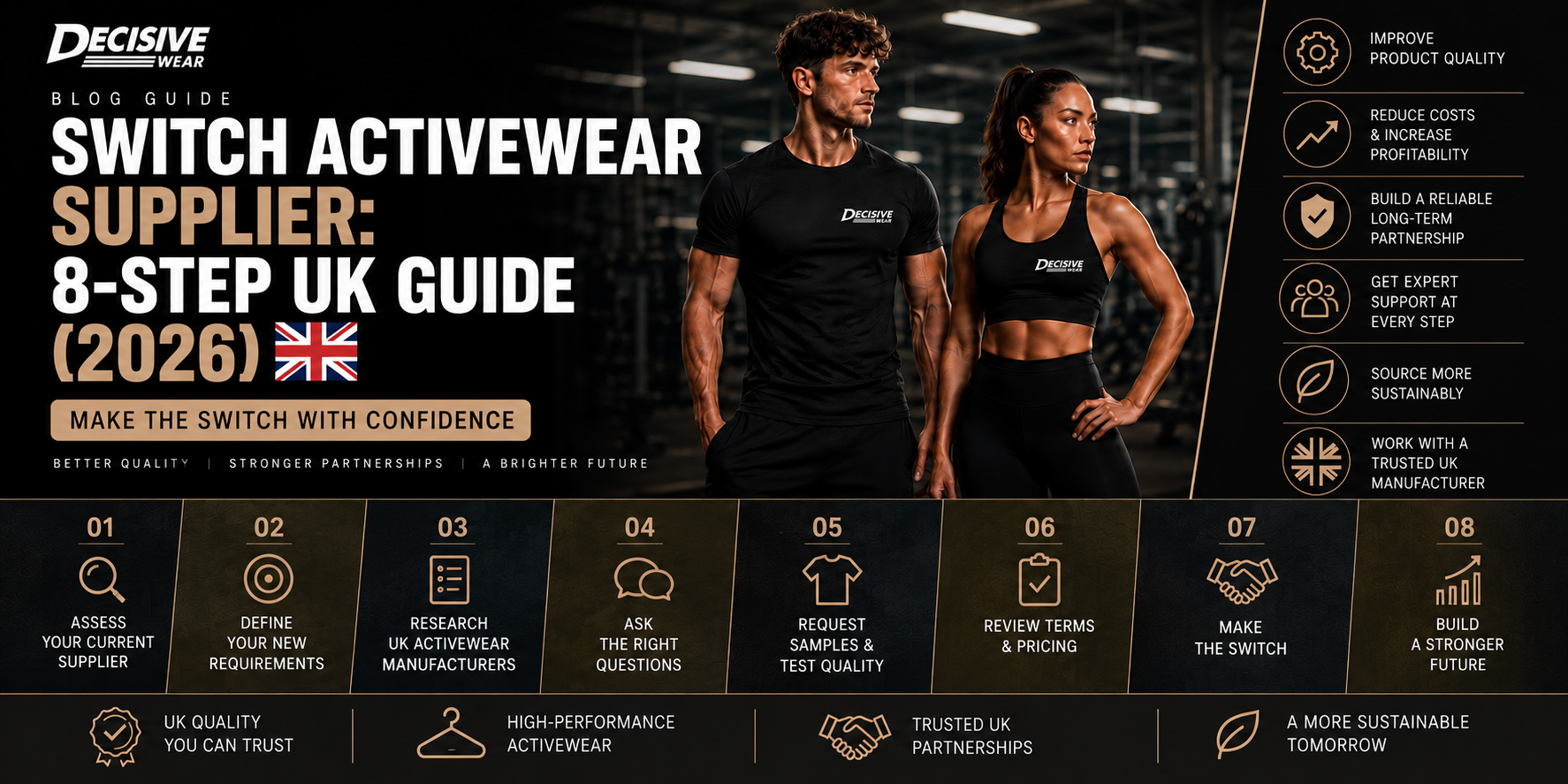
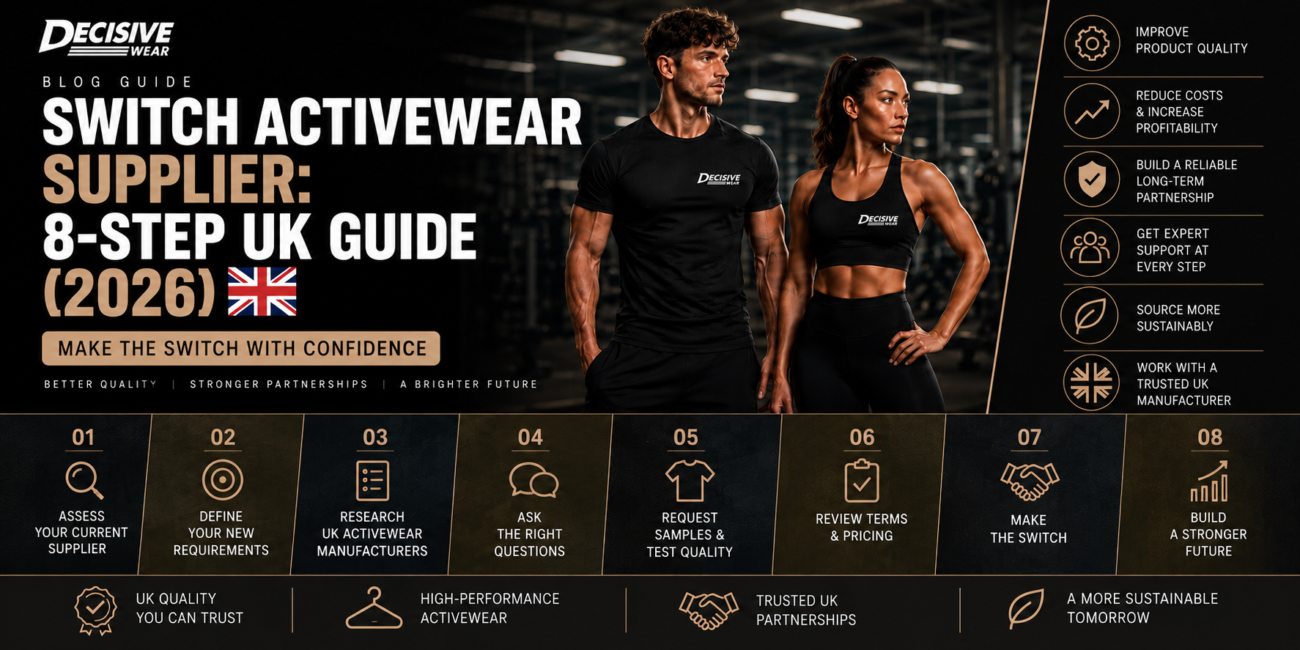
The 8-step process to switch activewear supplier
Run these in order. Steps 1 to 4 happen quietly while your current supplier is still producing.
Step 1 — Shortlist three manufacturers, not one
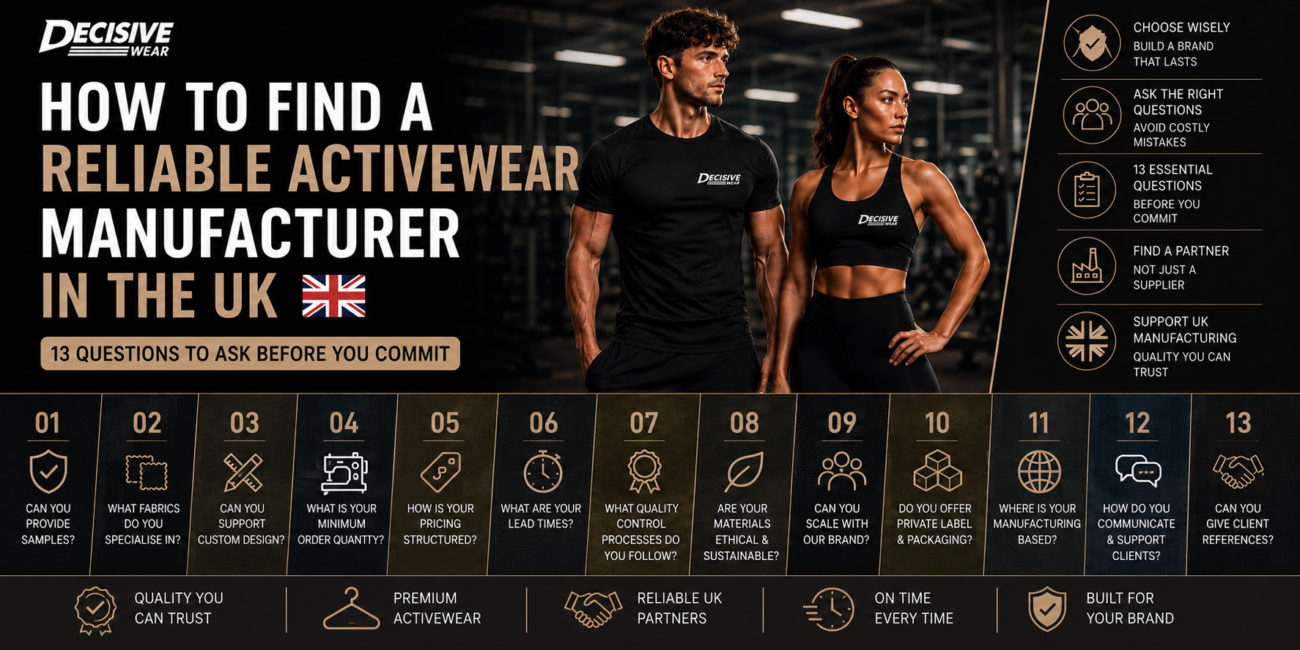
Three gives you comparable quotes and a genuine fallback. Our list of 13 questions to ask a UK activewear manufacturer works well as a screening call script.
Step 2 — Send an identical brief to all three
Same tech pack, same quantities, same delivery terms. Ask specifically for DDP pricing rather than FOB or EXW, so you are comparing true landed cost rather than a gate price.
Step 3 — Order a paid counter-sample against your gold sample
Never judge a factory on their showroom samples. Give them your existing garment and ask them to match it. As a result, you see their real capability, not their best-case marketing.
Step 4 — Measure the counter-sample against your spec sheet
Check every point of measure, not just the look. Wash it three times. Stretch it. Compare hand-feel side by side under the same light.
Step 5 — Place a small bridging order
Move one style, in one or two colourways, at low volume. Low minimums matter here. Our ODM route starts at 35 pieces per style and colour, which makes a trial genuinely low risk.
Step 6 — Sell that bridging order and watch the data
Track returns rate, size complaints and review sentiment for six to eight weeks. Your customers are the only quality control that actually counts.
Step 7 — Overlap your suppliers deliberately
Keep your current factory producing your top two SKUs while the new one proves itself on the rest. Consequently, you never sit with zero coverage.
Step 8 — Migrate the full range and formalise the terms
Once two consecutive bulk runs land on spec and on time, move everything. Lock in written terms for defect liability, lead times and price validity.
How long does it take to switch activewear supplier?
Plan for a full quarter. A realistic UK timeline looks like this:
- Weeks 1–2: shortlisting, screening calls and brief distribution.
- Weeks 3–6: counter-sampling and fit approval.
- Weeks 7–13: bridging bulk production and delivery.
- Weeks 14–20: sell-through review, then full migration.
Because of that, the worst time to start is when you are already out of stock. Begin the process while your current supplier is still performing acceptably. You will negotiate far better from a position of choice than from a position of panic.
What the move actually costs
Budget for the transition rather than pretending it is free. Typical one-off costs include counter-sampling at roughly £150–£400 per style, new label and trim setup, and a short period of carrying slightly more stock than usual during the overlap. Set against that, brands routinely recover the outlay within one or two seasons through fewer defects, fewer stockouts and lower discounting. Our guide to activewear manufacturing costs in the UK breaks the unit economics down in detail.
Three quotes that should stop you signing
- A price far below everyone else. Something has been removed — usually fabric weight, seam quality or accountability.
- No written defect policy. Ask directly: what happens if 4% of the run is faulty? A vague answer is an answer.
- Ex-works only. If they will not quote delivered duty paid, you are absorbing every logistics risk yourself. Check your commodity code on the UK Trade Tariff before you accept an EXW quote.
Frequently asked questions
Should I tell my current supplier I am looking?
Not until you have your tech packs, grading and gold samples in hand. Once those are secured, a straightforward conversation is fine and often improves their service immediately.
Can I use two activewear suppliers permanently?
Yes, and many established brands do. Dual sourcing protects you against capacity shocks and gives you a live price benchmark every season.
Will my fit change?
Not if you supply graded specs, tolerances and a sealed gold sample, and then verify the counter-sample point by point. Fit drifts when brands hand over a photo instead of a specification.
Ready to run a low-risk trial?
Decisive Wear works with established UK brands moving away from unreliable factories. We quote DDP to your UK door with duty and clearance included, start from 35 pieces per style on ODM and 100 on OEM, and we will counter-sample against your existing garment before you commit to anything. See how our ODM and OEM process works, or send us your tech pack for a like-for-like quote.