Importing activewear from China direct from the factory looks unbeatable on a spreadsheet. You see a £4.20 FOB price, you compare it to a £7.90 delivered quote, and the decision seems obvious. However, FOB is a gate price, not a landed price. By the time the goods reach your unit in the UK, that £4.20 has usually become something closer to £7 — and that is before you count the cost of your own time.
This article rebuilds the true landed cost line by line, so established UK brands can compare direct importing against a UK-managed, duty-paid supply partner on equal terms.
What FOB actually excludes
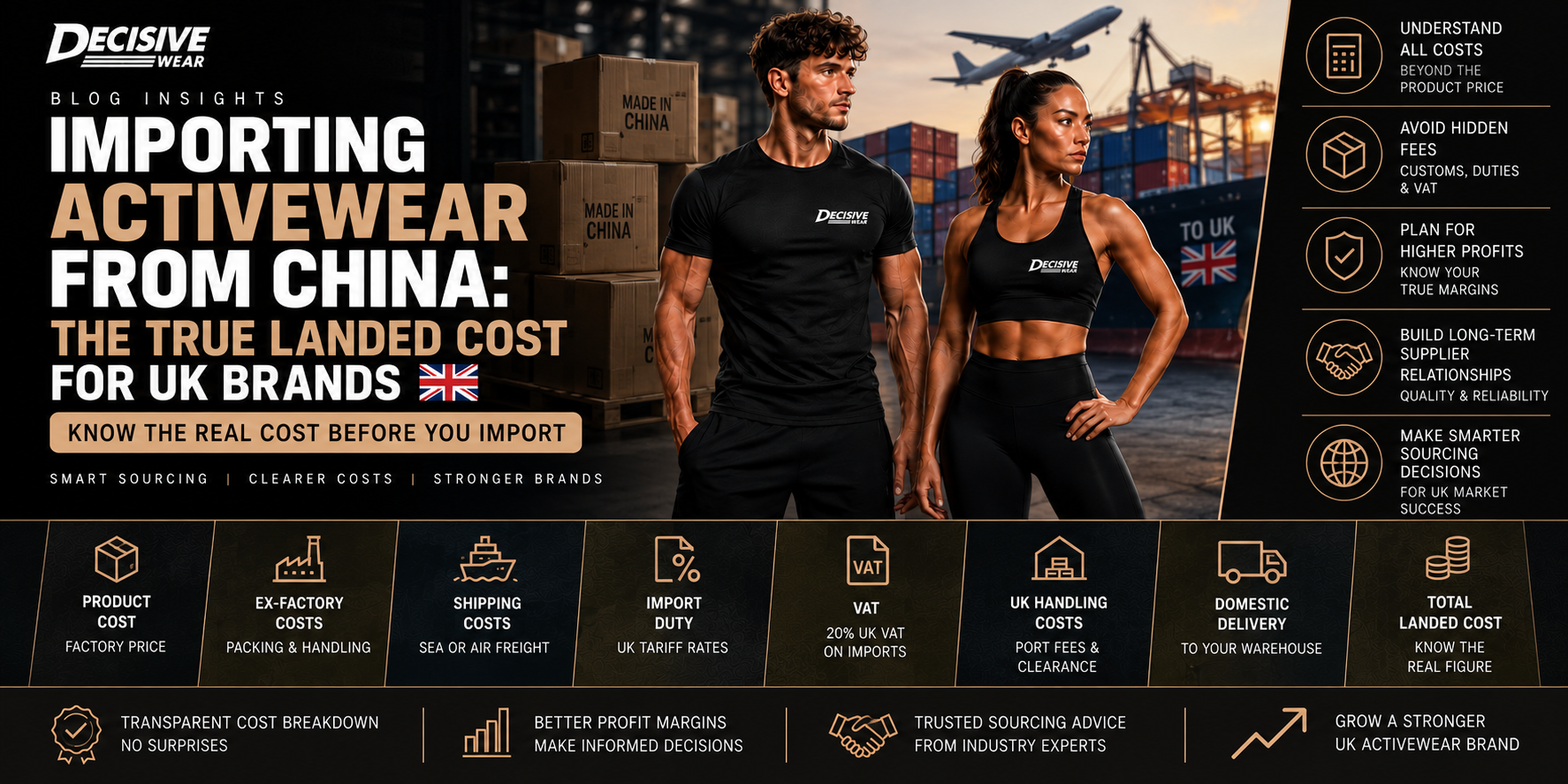
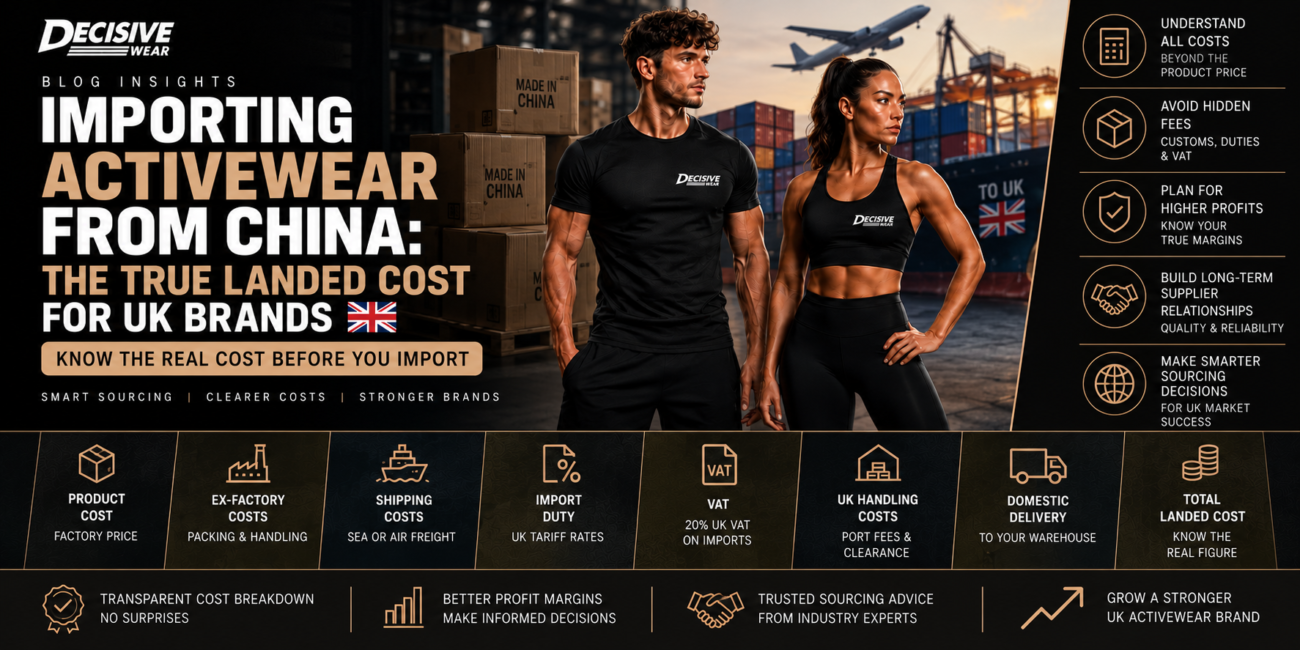
FOB means the factory gets your goods onto the vessel. Everything after that is yours. In other words, the quote you are celebrating covers roughly 60% of what you will eventually pay. The remaining 40% sits in these lines:
- Ocean or air freight — volatile, and it has swung hard in recent years with Red Sea rerouting.
- Import duty — apparel commodity codes typically attract meaningful duty. Check yours on the UK Trade Tariff before you model anything.
- Import VAT at 20% on the landed value, recoverable but a real cash-flow hit.
- Customs brokerage and entry fees per shipment.
- Port charges, haulage and unloading to your warehouse.
- Demurrage if clearance stalls, charged per container per day.
- Inspection — a third-party QC visit if you are not flying out yourself.
None of those appear in the factory quote. All of them appear on your P&L.
A worked example of importing activewear from China
Take 1,000 units of a mid-weight training hoodie at £4.20 FOB. Add freight, duty, VAT cash-flow, clearance, haulage and a modest inspection budget, and the delivered unit cost lands in a very different place. The exact figure depends on your commodity code, carton volume and freight rate on the week you ship — which is precisely the problem. You are pricing your retail range against a number you cannot fix in advance.
Meanwhile, a DDP quote gives you one figure that includes duty, clearance and delivery to your door. You can build your margin model around it and it does not move when a shipping index does.
The costs that never make it onto the spreadsheet
Unit economics are only half the story. The hidden operational costs are usually larger, and they compound:
Cash tied up for months
Direct importing typically means 30% deposit up front and the balance before the goods sail. Consequently, your working capital sits in a container for six to ten weeks while your competitors are restocking.
High MOQs forcing dead stock
Container economics push factories to quote 500 or 1,000 units per colourway. You order six colourways, two sell, four sit. That unsold stock is a real loss disguised as an asset on your balance sheet. Our guide on MOQ in activewear manufacturing explains how to size a first order properly.
Your own time
Freight forwarder chasing, customs paperwork, sample courier tracking and time-zone-delayed quality disputes are not free. For a founder-led brand, that is easily a day a week during a production cycle.
Defect risk with no recourse
Once goods clear customs, returning a faulty run to an overseas factory is commercially unrealistic. Therefore, most brands absorb the defects and quietly discount them.
Importing activewear from China vs a UK-managed supply partner
To be clear, this is not an argument that overseas manufacturing is wrong. Most quality activewear in the world is made in Asia, and that includes ours — our production sits in India while our commercial team is based in Hertfordshire. The real question is not where the sewing happens. It is who carries the risk between the factory floor and your warehouse.
Three models are available to a UK brand:
- Direct import, FOB. Lowest gate price, highest risk, most admin, most volatile landed cost.
- Trading agent. Less admin, but you add a margin layer and still rarely get a fixed delivered price.
- UK-managed DDP partner. One delivered price, duty and clearance included, UK contract and UK accountability for defects.
For a brand doing meaningful volume, the third model usually wins on total cost even when the headline unit price is higher. You are buying predictability, and predictability is what lets you plan a range.
When direct importing genuinely is the right call
Be honest about scale. Direct importing starts to pay off when you are shipping full containers regularly, you have someone in-house who owns logistics, and your styles are stable enough that a 1,000-unit colourway commitment is not a gamble. Below that threshold, the savings are usually theoretical.
If you are still weighing custom production against buying blanks, our comparison of custom gym wear versus blank wholesale activewear is a useful companion read.
How to compare quotes properly
- Ask every supplier for a DDP price to your postcode. If they cannot give one, price the difference yourself before comparing.
- Model the cash-flow gap, not just the cost. Deposit date to sellable date is the number that matters.
- Add a 3–5% defect allowance to any quote with no written defect policy.
- Divide unavoidable dead stock across your sellable units. High MOQs get expensive fast.
- Compare like for like on fabric. A cheaper hoodie is often a lighter one — check the spec against our activewear fabric guide.
Frequently asked questions
Is DDP always more expensive than FOB?
On the headline number, yes. On landed cost, frequently not. DDP simply moves costs you were going to pay anyway into a single quoted figure.
Do I still pay import VAT on a DDP order?
Under a true DDP arrangement the supplier clears the goods and settles duty. Confirm the VAT treatment and your evidence for recovery with your accountant before your first order.
What about tariffs changing?
Rates and preference schemes move. A fixed DDP price shifts that exposure onto your supplier rather than onto your margin mid-season.
Get a like-for-like landed cost comparison
Send us the spec of a garment you currently import and we will quote it DDP to your UK address, duty and clearance included, so you can compare against your real landed cost rather than your FOB price. See our ODM and OEM manufacturing options or request a quote. If you are already planning a move, our step-by-step guide to switching activewear supplier safely covers the transition.