Blog

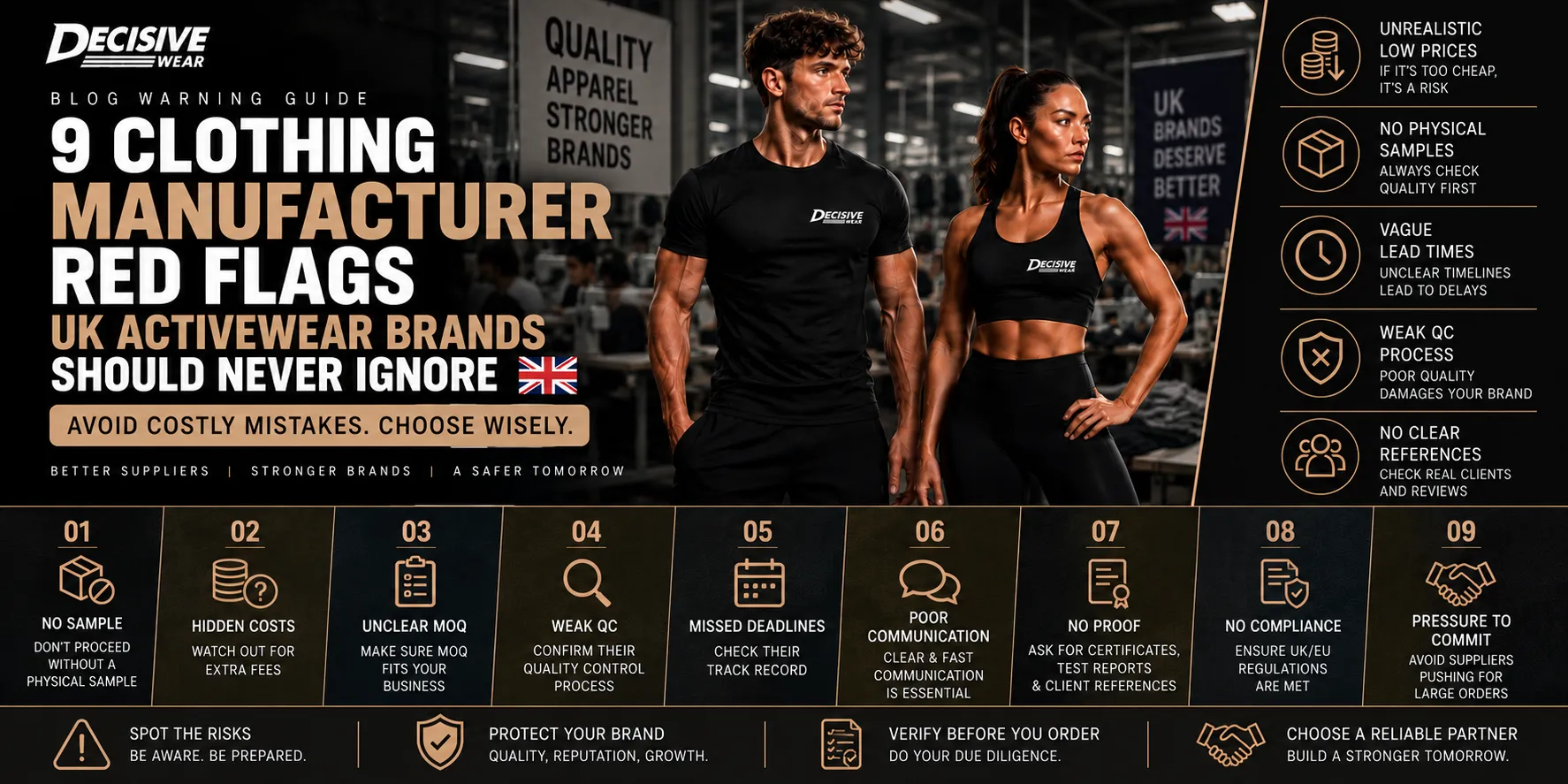
Most brands do not leave a factory over one disaster. They leave after two years of small clothing manufacturer red flags that each seemed tolerable on their own. A week late here. A slightly thinner fabric there. An unanswered email on a Friday. Individually, none of it justifies a move. Collectively, it quietly eats your margin and your reputation.
This is a diagnostic, not a complaint list. Work through the nine signals below and score your current supplier honestly. If you tick four or more, the commercial case for change is already made.
The nine clothing manufacturer red flags
1. Quality drifts between bulk runs
The sample was excellent. Order one matched it. Order four came back with looser stitching and a lighter hand-feel. This is the single most common of all clothing manufacturer red flags, and it usually means the factory is substituting fabric or subcontracting without telling you. Keep a sealed gold sample from your best run and measure every delivery against it.
2. Lead times slip and nobody warns you
Delays happen everywhere. The red flag is not the delay — it is finding out about it yourself. A supplier who tells you in week two that week eight is at risk is a partner. One who goes quiet until you chase is a liability.
3. They will not quote delivered duty paid
If a factory only quotes ex-works or FOB, they are handing you every logistics and customs risk while keeping the headline price attractive. Ask for a DDP figure to your postcode. Their reaction tells you a lot. Our breakdown of the true landed cost of importing activewear shows what that gap really costs.
4. No written defect policy
Ask one question: what happens if 5% of the run arrives faulty? A supplier with a process will describe it immediately. A supplier without one will change the subject. Because defects are inevitable at scale, the absence of a policy simply means you absorb them.
5. Communication runs on their schedule, not yours
Every question costing a full working day is not merely annoying. It stretches your development cycle, delays sign-off and pushes launches past the season you planned them for.
6. Rising MOQs as you grow
A supplier who increases minimums each season is telling you that your account no longer suits their capacity planning. Meanwhile, you are forced into colourways you did not want and dead stock you cannot sell. Our guide to MOQs in activewear manufacturing explains what a reasonable structure looks like.
7. They hold your patterns and grading
This is the most dangerous of the clothing manufacturer red flags because it is invisible until you try to leave. If your graded specs and patterns exist only on their server, they own your fit. Request everything now. Our tech pack guide lists exactly what a complete handover should include.
8. Vague answers on fabric specification
A competent factory states composition, GSM, knit structure and finish without hesitation. Vagueness usually means the mill changes between runs. Compare their answers against our GSM and fabric weight guide and see whether the numbers stack up.
9. Your returns rate is climbing
This is the commercial signal that outranks all the others. Sizing complaints, seam failures and colour mismatch reviews are your customers doing quality control for you. Track returns by SKU and by production batch. The pattern is usually obvious once you look.
Score your supplier
Count your ticks and read the result honestly:
- 0–1 flags: a solid relationship. Document your specs anyway and keep a second supplier warm.
- 2–3 flags: fixable. Raise them formally, in writing, with a defined review date. Many factories improve sharply when they realise the account is at risk.
- 4–6 flags: start sampling elsewhere now, while your current supplier is still shipping. Do not wait for a crisis.
- 7+ flags: you are running a business on someone else’s goodwill. Move.
What to do before you act on these red flags
Do not give notice first. Secure your production assets first, because leverage evaporates the moment they know you are leaving. Specifically:
- Request digital tech packs and graded specs for every live style.
- Get two sealed gold samples per style shipped to you.
- Collect vector artwork for all labels, trims and packaging.
- Record fabric composition, GSM and Pantone references for every colourway.
- Only then, open conversations elsewhere.
Once those are in hand, follow our full process for switching activewear supplier without losing stock or quality.
Red flags on the new supplier’s side
Apply the same scepticism to whoever you speak to next. Be wary of a quote materially below every other quote, an unwillingness to counter-sample against your existing garment, no named UK contact, and no clear position on who owns the tooling and patterns. In addition, always check that the company is a real registered entity with a traceable trading history.
Frequently asked questions
Should I confront my supplier about these issues?
Yes, but only after your tech packs and gold samples are secured. A clear written list of issues with a review date is professional and often effective.
How many suppliers should an established brand have?
At least two. Dual sourcing protects you from capacity shocks and gives you a live price benchmark every season without any drama.
Is a low price always a red flag?
Not always, but it demands an explanation. Ask what specifically makes them cheaper. A good factory will point to capacity, fabric sourcing or process. A weak one will simply repeat the number.
Test us against your current supplier
Send us a garment you are unhappy with. We will counter-sample it, quote DDP to your UK address with duty and clearance included, and let you compare it side by side before you commit to anything. Minimums start at 35 pieces per style and colourway on ODM. See how our ODM and OEM process works or get in touch with our Hertfordshire team.
