Blog
Tech Packs Explained: What Your Manufacturer Actually Needs From You (Free Checklist)

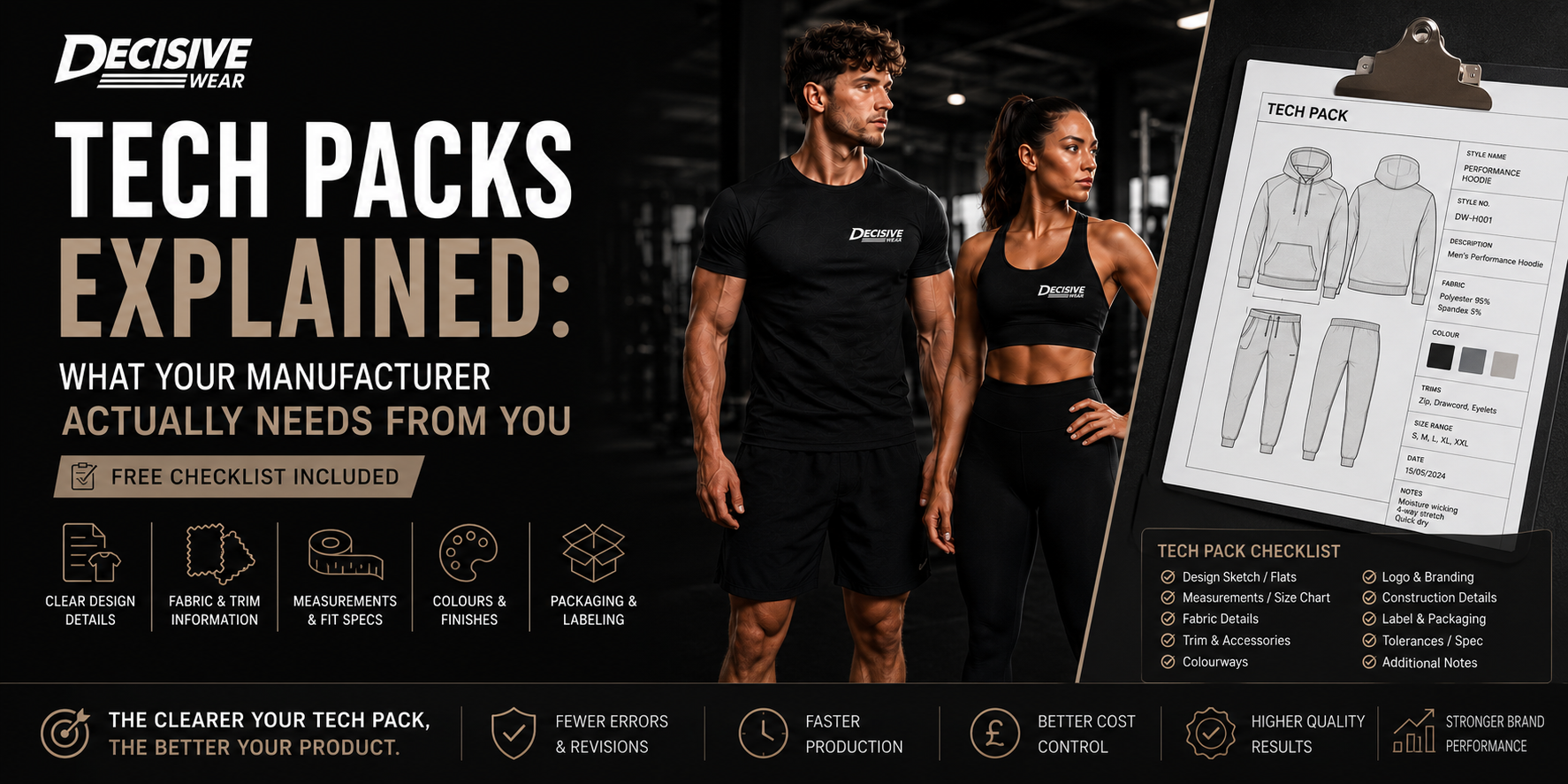
A tech pack is the instruction manual for your garment. In other words, it is the document that tells a manufacturer exactly what to make, down to the stitch. It covers your design sketches, fabric specification, measurements, trims, branding and construction details in one file. As a result, your idea becomes something a factory can produce without guessing.
Why should you care this much about a document? Because guessing is expensive. For example, a complete tech pack typically gets a brand to an approved sample in one or two rounds. An incomplete one, however, means three or four rounds of back-and-forth. Moreover, each round costs weeks. We review tech packs from UK brands every week, so we know exactly where they go wrong. Therefore, this guide covers what manufacturers actually need, what’s optional, and the mistakes that quietly delay launches.
Do You Even Need a Tech Pack?
First, an honest filter — because not every brand needs one. In fact, it depends entirely on your manufacturing route:
- Private label / ODM: no tech pack needed. You’re selecting proven designs from a catalogue and adding your branding. In this case, the patterns and specs already exist. Our OEM vs ODM guide explains this route in full.
- Custom / OEM: a tech pack is the starting point. Here, your unique design has to be communicated precisely. That said, a missing tech pack isn’t a dead end. Our design team regularly develops sketches and reference garments into full production specs. However, it adds development time and cost.
In short, this guide is for brands going custom — or graduating a proven ODM style into an exclusive OEM piece.
The 9 Sections of a Tech Pack (What Manufacturers Actually Read)
1. Cover sheet. This holds the style name and number, season, date and — most importantly — a revision number. Factories work from documents. Consequently, when “final_v2_NEW” and “final_v2_NEWEST” both exist, the wrong one gets made. Version control sounds boring. Nevertheless, it prevents the most expensive mistakes.
2. Technical flat sketches. These are front and back line drawings of the garment, plus detail callouts for pockets, waistbands and seams. Importantly, these are flats, not fashion illustrations — no models, no shading, no artistic angles. Clean vector flats communicate; by contrast, mood-board imagery only decorates.
3. Fabric specification. This covers fibre composition, blend percentage, fabric weight and colour reference. For example: “76% recycled nylon / 24% elastane, 280gsm, Pantone 19-4052”. If you’re unsure on weights, our GSM guide gives ranges per garment. Likewise, the fabric guide covers fibre choice. Alternatively, reference a swatch code directly from our fabric swatch book — that removes all ambiguity.
4. Measurement spec — the most important page. This means a points-of-measure (POM) chart for your base size, plus a grading chart across your size range, plus tolerances. This page decides fit. In turn, fit decides returns. So if you only perfect one section, make it this one.
5. Bill of materials (BOM). This lists every component in the garment: main fabric, lining, elastic, drawcords, zips, thread and labels. Additionally, each line needs a placement and a quantity. Missing BOM lines are, in fact, the number-one cause of “why is my sample different?” emails.
6. Construction details. Specify stitch and seam types for key areas — for instance, flatlock on leggings seams, coverstitch on hems, bartacks on stress points. Don’t know the terminology? In that case, send reference photos of a garment with the construction you want. After all, a picture of the right seam beats a wrong technical term.
7. Branding and artwork. State logo placement with exact measurements (“70mm print, centred, 55mm below back collar”), plus the print method. Also supply artwork files in vector format (AI, EPS or PDF). Screenshots and Instagram exports are the classic failure here, because they cannot be printed sharply.
8. Colourways. Lay out each colour variant with Pantone references per component. “Navy” means ten different things; “Pantone 19-3933”, on the other hand, means exactly one.
9. Labels and packaging. Finally, include care label content (with UK legal requirements), brand label placement, folding and polybag instructions, and hangtags. This section is often forgotten, yet always needed before production. Therefore, decide it now — not during a production hold.
The Mistakes That Add Weeks to Sampling
Perfectionism before contact. Some founders spend months polishing a tech pack alone. Meanwhile, a 30-minute conversation with the manufacturer would have answered half their open questions. Instead, send a strong draft, then refine together. That is the fast path.
Copying measurements from a competitor’s size guide. Published size charts show body measurements, not garment measurements. Furthermore, they never include grading logic or tolerances. As a result, samples built from them fit badly. Measure an actual garment that fits well instead.
No tolerances. Manufacturing has natural variance. Consequently, a spec without tolerances (e.g. ±1cm on lengths, ±0.5cm on widths) makes every sample technically “wrong” and every approval a negotiation. Set tolerances, and both sides know what a pass looks like.
Ignoring MOQ reality during design. Every extra colourway and fabric multiplies your minimums. For this reason, design the range with production maths in mind — our MOQ guide shows how quantities stack across styles and colours.
Free Tech Pack Checklist
Here’s the full checklist we wish every brand used. Work through it before sending your pack, and your first sample round will thank you:
- ☐ Cover sheet with style number, season, date and revision number
- ☐ Front and back technical flats with detail callouts
- ☐ Fabric spec: composition %, GSM, Pantone or swatch code
- ☐ POM measurement chart for base size
- ☐ Grading chart across full size range
- ☐ Tolerances stated for every measurement
- ☐ Bill of materials — every trim, with placement and quantity
- ☐ Stitch/seam types for key construction points (or reference photos)
- ☐ Branding placements with exact dimensions
- ☐ Artwork supplied as vector files (AI / EPS / PDF)
- ☐ Colourways with Pantone references per component
- ☐ Care label content and brand label placement
- ☐ Packaging and folding instructions
- ☐ One question list for the manufacturer — the things you’re unsure about
Want this as a printable PDF template? Download the free Decisive Wear Tech Pack Checklist and we’ll send it straight to your inbox — [REPLACE WITH BREVO FORM / DOWNLOAD LINK].
Frequently Asked Questions
What is a tech pack in clothing?
A tech pack is a technical document that specifies everything a manufacturer needs to produce a garment. Specifically, it includes flat sketches, fabric details, measurements with grading, trims, construction methods, branding and packaging. In short, it is the single source of truth for production.
How much does a tech pack cost?
Freelance tech pack designers typically charge £75–£300 per style, depending on complexity. Alternatively, manufacturers with in-house design teams — including us — can develop your sketches or reference garments into production specs as part of the OEM process.
Do I need a tech pack for private label activewear?
No. Private label (ODM) uses the manufacturer’s existing designs, so the specifications already exist. Instead, you only choose fabrics, colours and branding. Tech packs are therefore for custom (OEM) manufacturing.
Can I send a manufacturer a sample garment instead of a tech pack?
Yes. In fact, a reference garment plus notes on what to change is a legitimate starting point — and often better than a poor tech pack. The manufacturer’s pattern team then develops the formal spec from it.
What software is used to make tech packs?
Adobe Illustrator is the industry standard for flats and layout. However, many brands use Canva, Figma or dedicated tools like Techpacker. Ultimately, the format matters less than the completeness — a clear PDF beats a fancy incomplete file.
Send Us Your Tech Pack — Or Let’s Build It Together
Decisive Wear manufactures custom activewear for UK brands from 100 pieces per style. Additionally, we offer in-house design support for brands that have the vision but not the document. Have a tech pack ready? Then we’ll review it and flag gaps before sampling, free. Starting from sketches? In that case, we’ll develop the spec with you.
See how our OEM / ODM process works →
Ready to move? Get in touch or send your tech pack over WhatsApp. We’ll come back with honest feedback and a sampling quote.
