Blog

How Much Does It Cost to Manufacture Activewear in the UK? (2026 Price Breakdown)
So how much does it cost to manufacture activewear in the UK? Ask most factories and you’ll get the same frustrating answer: “it depends.” True — but useless when you’re trying to build a business plan. This guide gives you the real numbers behind manufacturing activewear in the UK in 2026: what each cost component actually is, what a first order typically comes to, and how to keep your launch budget under control.
The short answer
For a UK brand launching a single style, the realistic all-in cost to manufacture custom activewear in the UK is around £2,000–£5,000 for your first order. That figure covers sampling and a bulk production run of roughly 100 pieces, and it’s one of the most accessible entry points in the UK custom activewear market.
That headline number moves depending on three things: the garment you’re making, the fabric and construction you choose, and how many units you order. Below, we break every one of those variables down so you can build an accurate budget rather than guess.
Want an exact figure for your product? Every spec prices differently. Request a transparent quote from our ODM/OEM team and we’ll give you real per-unit and total costs — no hidden extras.
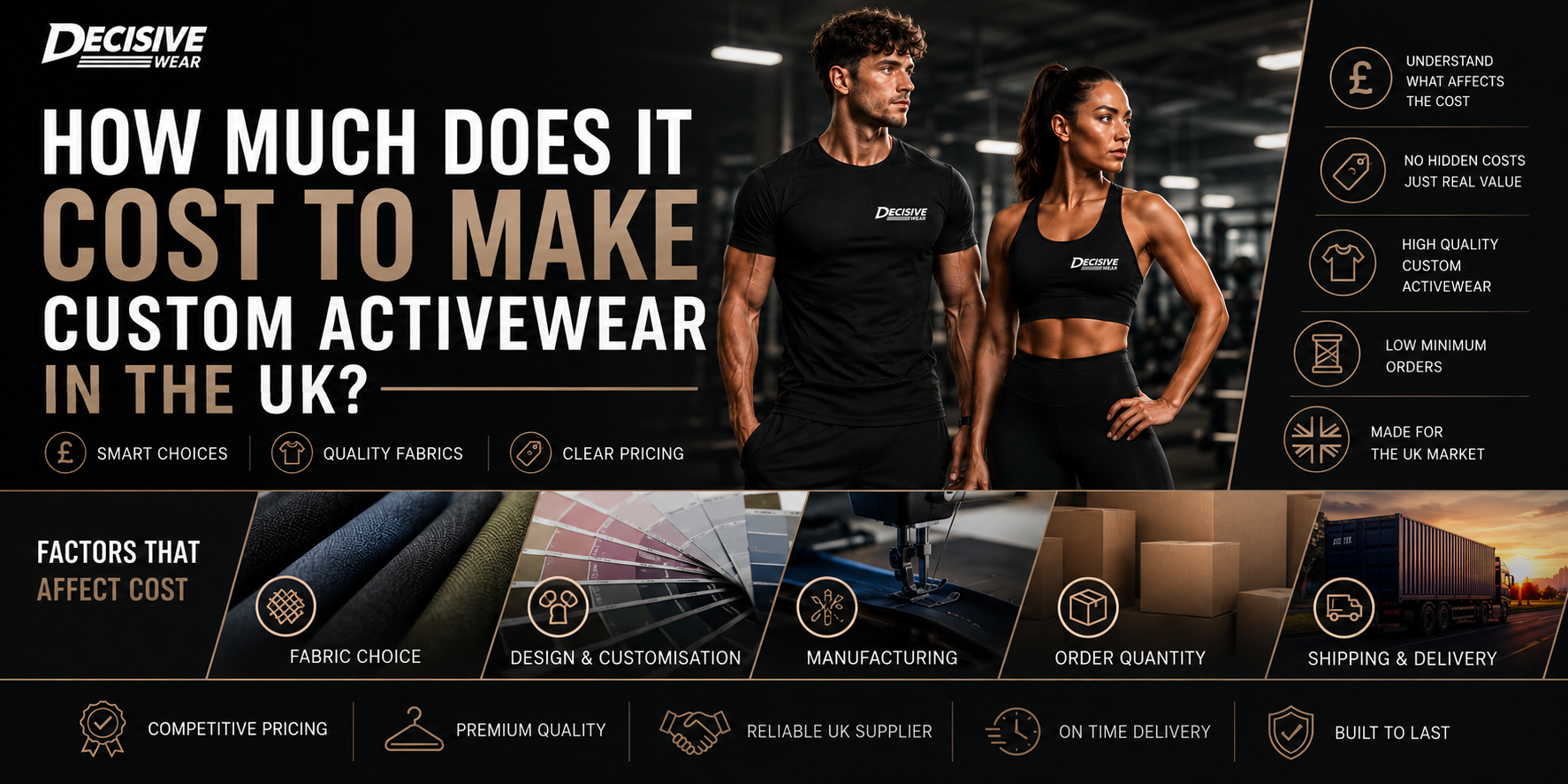
The 6 real costs of manufacturing activewear in the UK
Your final invoice is really six separate costs stacked together. Understanding each one tells you exactly where your money goes — and where you can save it.
1. Sampling and development
Before a single bulk unit is made, your design has to be turned into a physical, wearable sample. This is where your tech pack becomes essential — the clearer your tech pack, the fewer sample rounds you’ll pay for.
As a guide, expect £150–£400 per style for sampling, depending on complexity. A plain t-shirt sits at the lower end; a compression legging with mesh panels, colour-blocking and a printed waistband sits at the top. Most brands budget for one to two sample rounds before approving production.
2. Fabric — the biggest single variable
Fabric is usually the largest slice of your per-unit cost, and it’s the one you control most directly. Two decisions drive the price: the type of fabric and its weight.
A lightweight recycled polyester behaves — and costs — very differently to a heavier premium nylon-elastane blend. Fabric weight is measured in GSM, and it directly affects both feel and cost: heavier fabric means more material per garment. If you’re unsure which weight suits your product, our GSM and fabric weight guide breaks down the right range for leggings, tops and hoodies, and our activewear fabric guide compares polyester, nylon, bamboo and recycled options side by side.
3. Cut, sew and construction
This is the labour of actually building the garment — cutting the panels, stitching the seams, and applying the finishing. Construction complexity is a real cost driver. Flatlock seams, gussets, pockets, mesh inserts and bonded (seamless-style) finishing all add labour time, and therefore cost, compared with a simple two-panel garment.
The practical takeaway: every extra construction feature you add to your first product raises your unit price. For a debut range, keeping construction clean and confident often protects both your margin and your timeline.
4. Branding, printing and trims
Your branding package is what turns a blank garment into your product — and the decoration method you choose has a real impact on cost. Here’s how the main options compare for UK activewear:
| Method | Best for | Durability | Cost note |
|---|---|---|---|
| Sublimation | All-over, full-colour prints on polyester | Excellent — dye is infused into the fabric, won’t crack or fade | Great value for bold, full-garment designs; polyester only |
| Screen printing | Simple logos, limited colours, larger runs | Very good | Cost-effective at volume; setup cost per colour |
| Embroidery | Chest logos, premium finish, waistbands | Best — thread won’t crack or peel | Premium look; one-off digitising fee (roughly £15–£30) |
| DTF (heat transfer) | Small runs, mixed colours, full-colour detail | Good | Flexible for low quantities; less ideal for heavy-wear items |
Beyond decoration, your trims also carry cost: custom woven neck labels, printed care labels, hang tags and branded packaging. These aren’t afterthoughts — they’re the first thing a customer touches when the parcel arrives, and they signal quality before the garment is even tried on.
5. MOQ — how order size moves your unit price
Minimum order quantity (MOQ) is one of the biggest levers on your per-unit cost. The more units you order per style, the lower the cost of each one, because fixed costs like setup and sampling are spread across a larger run.
That’s the classic trade-off: order small to reduce your upfront risk and you’ll pay more per unit; order larger to drop your unit cost and you’ll commit more cash and inventory. We cover exactly how this works, and how to find the sweet spot, in our full guide to MOQ in activewear manufacturing.
6. Shipping, duties and DDP
The final cost is getting your finished stock to your door. This is where brands are most often caught out — a low unit price can be wiped out by surprise freight and customs charges on arrival. If you’re importing, it’s worth checking the current rates on the UK Trade Tariff so you know what duties could apply.
The way to avoid that headache is DDP (Delivered Duty Paid) pricing, where shipping and duties are included in your quoted price so there are no separate charges to settle later. With Decisive Wear, DDP shipping is built into your quote, so the number you agree is the number you pay.
Full cost breakdown by production tier
Here’s how those components typically come together when you manufacture activewear in the UK across three stages of growth. These figures are an indicative guide for planning — your exact quote depends on garment, fabric and specification.
| Stage | Order size | Typical use | Indicative total budget |
|---|---|---|---|
| Starter (debut) | ~100 units, single style | Testing the market, first drop | £2,000–£5,000 incl. sampling |
| Growth | Multiple styles / larger runs | Full collection, restocks | Scales with styles and volume — lower unit cost |
| Established | High-volume, repeat production | Proven sellers, wholesale | Best unit economics; request bulk pricing |
The important insight: your unit cost drops as you grow, but your total spend rises because you’re ordering more. A smart first order tests demand at the lowest sensible risk before you scale.
Custom (ODM) vs blank wholesale: the cost trade-off
Not every brand needs full custom manufacturing on day one. Buying blank wholesale stock and adding your own branding is cheaper to start, but limits how much you can differentiate. Custom (ODM/OEM) manufacturing costs more upfront but gives you a genuinely unique product with your own fit, fabric and design.
Which model is right depends on your goals and budget. We compare both in detail in custom gym wear vs blank wholesale activewear, and if you’ve already decided to go custom, our guide to OEM vs ODM manufacturing explains the cost difference between the two custom models.
How to keep your first order affordable
You don’t need a huge budget to launch well. Five practical ways to protect your cash on your debut order:
- Start with one or two hero styles. A focused first drop is far cheaper than a sprawling collection — and easier to sell out.
- Nail your tech pack before sampling. Every sample round you avoid is money saved. A clear tech pack is the single best cost-control tool you have.
- Keep construction clean. Add mesh panels and complex seaming once you know a style sells, not before.
- Choose the right decoration for your quantity. Sublimation and DTF suit smaller, colourful runs; screen printing and embroidery reward volume.
- Order at a sensible MOQ. Big enough to get a workable unit price, small enough to limit risk while you validate demand.
Realistic budgets: what £2k, £5k and £10k get you
- £2,000–£3,000: A single hero style, sampled and produced at a starter MOQ with clean branding. Ideal for testing your first product with real customers.
- £4,000–£5,000: A stronger debut — one or two styles with more considered fabric, printing and premium trims for a genuinely retail-ready launch.
- £8,000–£10,000+: A small collection or a larger volume of your proven styles, unlocking better unit economics and room to invest in packaging and marketing stock.
Wherever you sit, the goal is the same: spend enough to launch a product you’re proud of, without over-committing before you’ve proven demand. If you’re still at the planning stage, our complete guide on how to start your own activewear brand in the UK walks you through the whole journey.
Frequently asked questions
How much does it cost to manufacture activewear in the UK?
For a UK brand launching a single style, expect around £2,000–£5,000 for a first order that includes both sampling and a bulk run of roughly 100 pieces. Your exact cost depends on the garment, fabric and order quantity.
How much does it cost to make gym leggings?
Leggings sit at the higher end of activewear complexity because of their fabric weight, stretch construction and squat-proof opacity requirements. Sampling typically runs £150–£400 per style, with bulk unit cost varying by fabric, GSM and finishing — request a quote for an accurate figure for your spec.
What is the minimum budget to start an activewear brand?
The minimum realistic entry point for a custom single-style launch with Decisive Wear is around £2,000, covering sampling and a starter production run. That makes custom manufacturing far more accessible than most UK brands assume.
Why do manufacturers quote per-unit costs instead of a fixed price?
Because no two products are the same. Fabric type, GSM, construction complexity, decoration method and order quantity all move the price. A per-unit quote reflects your specific garment rather than an average that would be wrong for most brands.
Are shipping and duties included in the price?
With DDP (Delivered Duty Paid) pricing, yes — shipping and duties are built into your quote, so there are no surprise charges on arrival. Always confirm whether a manufacturer quotes DDP before comparing prices.
Ready to see your real numbers?
Every activewear product prices differently — the only way to get an accurate figure is a proper quote against your spec. Explore our ODM/OEM manufacturing service or get in touch for a transparent, DDP-inclusive quote with no hidden costs.