Blog
OEM vs ODM Activewear Manufacturing: Which Model Fits Your Brand (With Real Cost Differences)

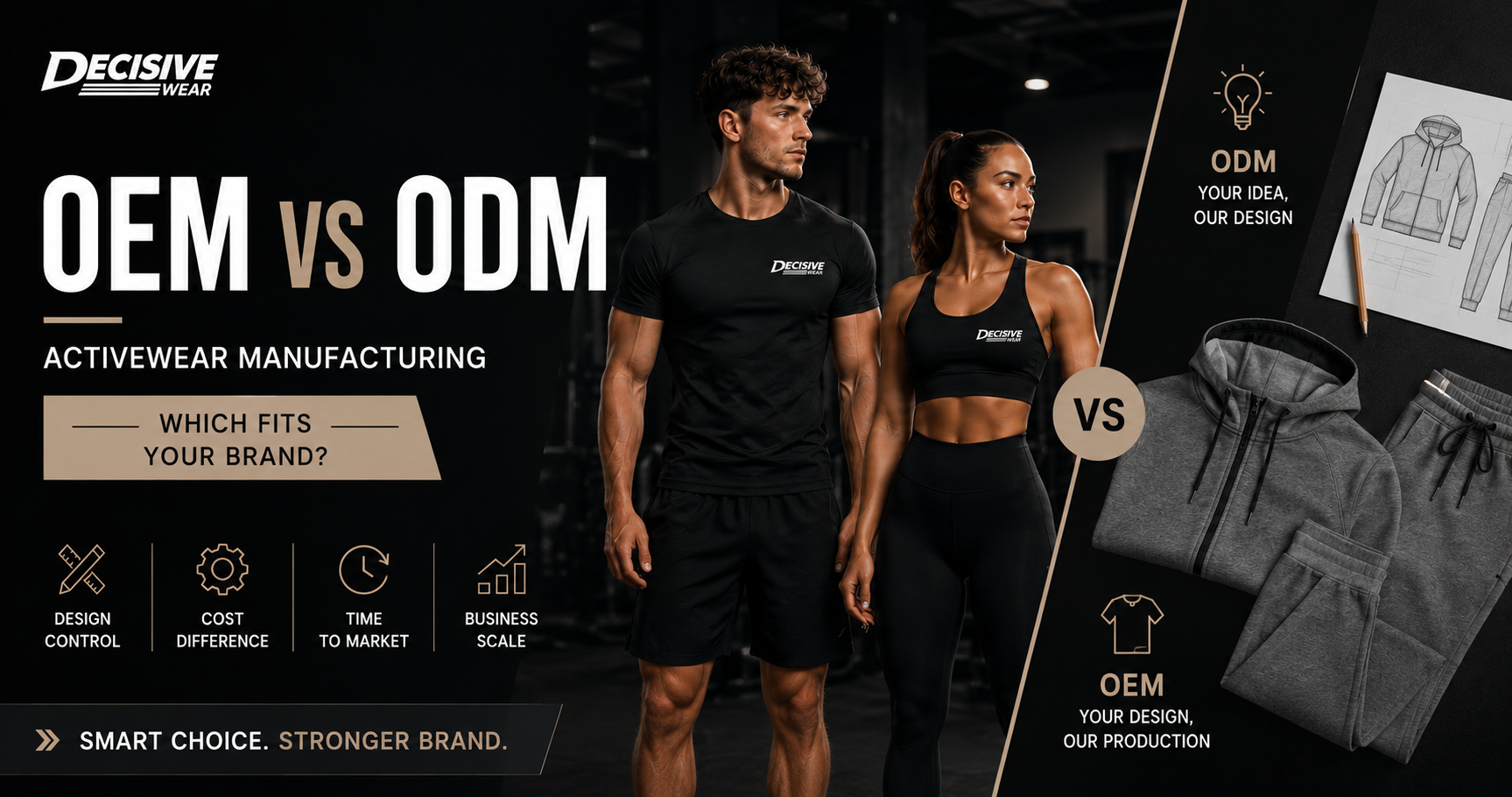
Every new activewear brand reaches the same fork in the road. You have a vision, a logo, and a mood board full of ideas. Then comes the big question: what will it cost to make? The answer starts with one decision — OEM vs ODM activewear manufacturing. In other words: do you put your brand on proven designs, or do you manufacture designs of your own?
This choice shapes everything downstream. It sets your minimum order quantity, your sampling budget, and your lead time. Moreover, it decides how defensible your brand will be in eighteen months. Most guides explain the acronyms and stop there. This one gives you real numbers, because we run both models every day.
OEM vs ODM Activewear: The Definitions in Plain English
ODM means Original Design Manufacturing. Here, the manufacturer has already done the design work. Patterns are graded, fabrics are tested, and the fit is proven across hundreds of production runs. You simply select from an existing catalogue of leggings, shorts, seamless sets and tees. After that, you choose your colours and fabrics, and add your branding — labels, prints, embroidery, packaging. The result is manufactured as your product. Many people call this “private label”. In activewear, the two terms mean almost the same thing.
OEM means Original Equipment Manufacturing. In this model, you bring the design and the manufacturer brings the factory. Your tech pack becomes a unique garment that nobody else can order. Don’t have a tech pack? No problem — the factory’s pattern team can develop one from your sketches. However, pattern making, fit development and several sampling rounds must all happen before production starts.
Neither model is “better”. Instead, they solve different problems at different brand stages. Furthermore, the right answer often changes as you grow.
OEM vs ODM Costs: The Real Differences
Here is the side-by-side comparison that actually matters. We’ve used our own production model as the reference point:
| Factor | ODM (Private Label) | OEM (Your Design) |
|---|---|---|
| Minimum order at Decisive Wear | 35 pieces per style | 100 pieces per style |
| Design & development cost | None — designs already exist | Typically £150–£400 per style, industry-wide |
| Sampling | 1 branded sample round | 2–3 rounds (fit → revised → pre-production) |
| Time to production-ready | 1–3 weeks | 4–8 weeks |
| Unit cost | Lower — development shared across brands | Higher — your order carries all development |
| Exclusivity | Shared silhouette; your branding differentiates | Fully exclusive to your brand |
| Best for | Launch, testing, gym merch, fast expansion | Proven brands and signature pieces |
Two rows deserve emphasis. First, the MOQ gap: 35 pieces for ODM vs 100 pieces for OEM is not arbitrary. An ODM run slots into proven production. An OEM run, on the other hand, carries setup costs that only make sense at volume. Second, look at the sampling rounds. OEM sampling is not a formality — it is where fit is won or lost. Therefore, budget for it honestly. Our MOQ guide explains why minimums exist and how to negotiate them.
The Hidden Trade-Offs Nobody Mentions
ODM’s hidden cost is differentiation debt. Your first collection can look professional on day one. However, if your bestseller is a catalogue silhouette, a competitor can order the same base garment next quarter. Smart ODM brands therefore differentiate where it’s cheap. That means fabric selection, colour strategy, branding execution and marketing. In fact, this is exactly what our fabric swatch book exists for. Plenty of seven-figure activewear brands still run substantially on ODM. Their moat is brand, not pattern.
OEM’s hidden cost is iteration risk. A brand-new design has not survived hundreds of production runs yet. As a result, it can surprise you — a waistband that rolls on certain body types, or a seam that chafes at scale. Sampling rounds exist to catch these issues. Consequently, your launch date depends on how fast you approve samples and how clear your feedback is. First-time founders who jump straight to OEM often lose two months to indecision, not manufacturing.
Cash flow decides more often than design ambition. For example, imagine a 5-style launch. At ODM minimums, that means 175 pieces. At OEM minimums, it means 500 pieces plus development on five styles. Same collection, radically different capital requirement. This is why we give launching brands the same advice as in our custom vs blank wholesale comparison: match the model to your stage, not your ego.
Which Model Fits Your Brand? A Simple Framework
Choose ODM if you are launching or under twelve months old. It also fits if you’re validating which styles sell, building branded gym merch, or expanding a range quickly. In short, choose ODM when your differentiation is fabric, colour and brand rather than construction.
Choose OEM if you have proven sell-through and reorder data. It’s the right call when a specific fit or feature is core to your positioning — for instance, a signature waistband or an inclusive sizing block. Similarly, choose OEM when customers now see your shared silhouette everywhere, or when wholesale buyers ask what makes your product different beyond the logo.
Choose both if you’re growing. This is the pattern we see most among successful UK brands. One or two OEM signature pieces anchor the brand’s identity. Around them, ODM styles fill out the collection profitably. The OEM pieces do the marketing; meanwhile, the ODM pieces do the margin. Because we run both models under one roof, brands can graduate styles from ODM to OEM as sales data justifies it — without switching manufacturers. You’ll find the full process for both routes on our ODM / OEM manufacturing page.
A Worked Example
A UK fitness coach comes to us with three styles in mind: leggings, a sports bra and an oversized tee. Under ODM, she selects proven silhouettes from our catalogue. Next, she picks a squat-proof 260gsm fabric from the swatch book and approves branded samples within a fortnight. She launches with 105 total pieces. The risk is modest, and the time to market is about a month.
Twelve months later, the leggings reorder monthly and customers keep praising the fit. However, two other brands have now launched on visually similar silhouettes. At this point, OEM makes sense for that one style. She invests in a custom pattern with her own waistband construction. Then she orders the 100-piece OEM minimum with confidence, because sales data has de-risked the decision. Meanwhile, the bra and tee keep running as ODM. That is model graduation working as intended — and it costs far less than starting with 500 OEM pieces of unproven designs.
Frequently Asked Questions
Is ODM the same as private label?
In activewear, effectively yes. Both mean applying your branding to a manufacturer’s existing, proven designs. “Private label” is the retail-side term, while “ODM” is the manufacturing-side term for the same arrangement.
What’s the minimum order for OEM vs ODM activewear?
At Decisive Wear, the minimum is 35 pieces per style for ODM and 100 pieces per style for OEM. Industry-wide, ODM minimums typically run 30–100 pieces. OEM minimums, by contrast, commonly start at 100–300 pieces, because custom development only pays off at volume.
Do I need a tech pack for OEM manufacturing?
A complete tech pack is the ideal starting point, but it isn’t a hard barrier. Our design team can develop sketches or reference garments into production-ready specifications. For ODM, no tech pack is needed at all.
Can I mix OEM and ODM in one collection?
Yes — and it’s usually the smartest structure for a growing brand. One or two exclusive OEM signature pieces work alongside profitable ODM styles. Keeping both with the same manufacturer keeps quality and fabrics consistent.
Which is cheaper per unit — OEM or ODM?
ODM, almost always. Development costs on ODM styles are shared across many brands. OEM development, however, sits entirely on your order. The gap narrows at higher volumes, which is why OEM suits proven styles rather than launches.
Talk It Through With a Manufacturer Who Runs Both
Decisive Wear manufactures both ODM and OEM activewear for UK brands. We offer 35-piece ODM minimums for launching and testing, plus 100-piece OEM runs with full design support. Either way, our fabric swatch book does the differentiating.
Explore our ODM / OEM manufacturing process →
Not sure which model fits your stage? Get in touch or message us on WhatsApp. We’ll tell you honestly — even when the answer is the cheaper one.