Blog
Activewear Fabric Guide: Polyester vs Nylon vs Bamboo vs Recycled — What UK Brands Should Choose

Choosing an activewear fabric is the single biggest product decision your brand will make. It decides how your garments feel in the hand, how they perform in a workout, how well your prints hold, and what your margins look like. Get it right and customers reorder. Get it wrong and no amount of marketing saves the returns rate.
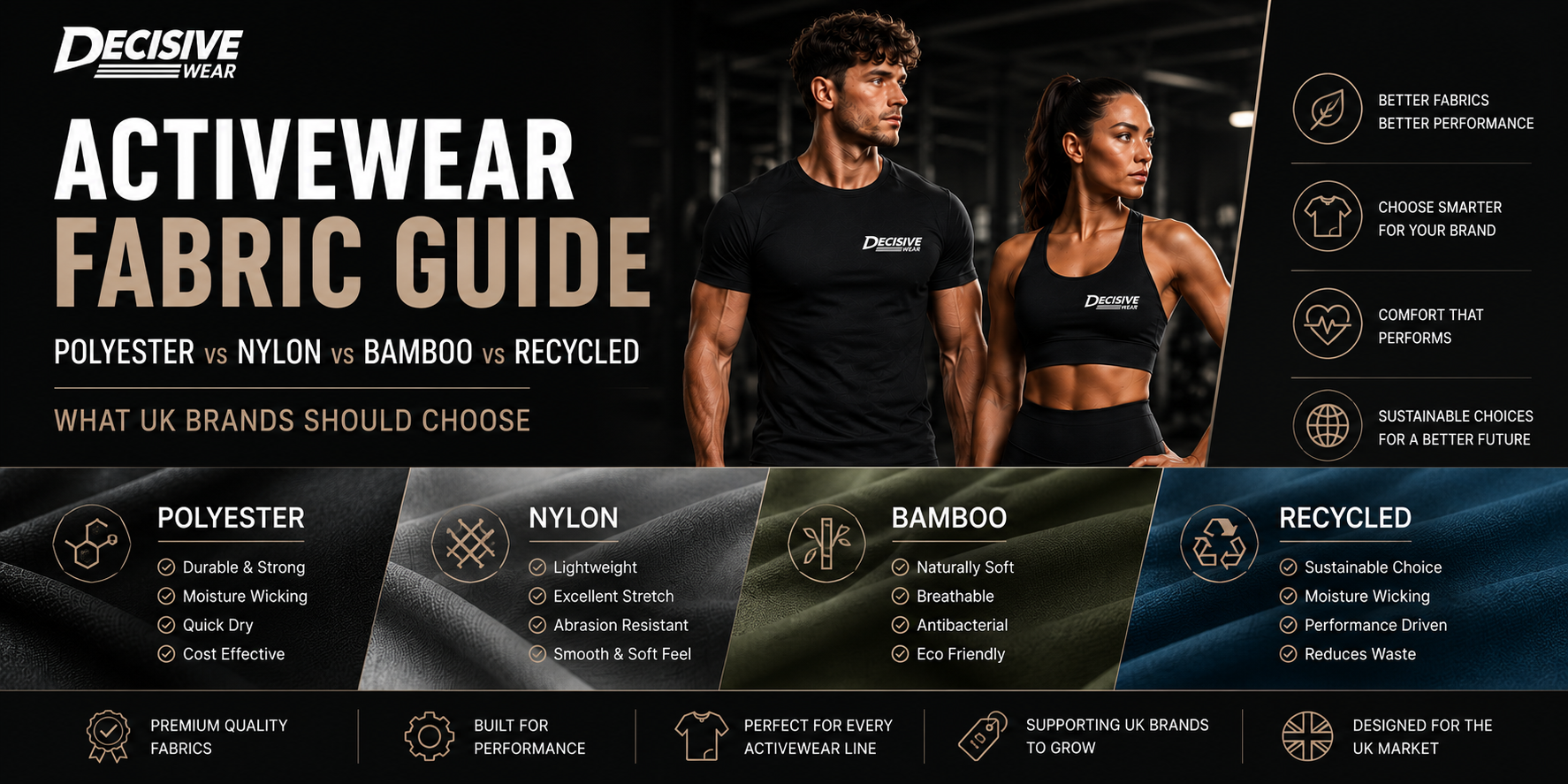
Yet most fabric advice online is written by retailers, not manufacturers. As a result, it stays vague — “polyester wicks moisture” and little else. This guide is different. We work with these fabrics on production lines every day, so we’ll compare polyester, nylon, bamboo and recycled options on the specs that actually matter. Then we’ll tell you which fabric suits which garment, honestly.
Activewear Fabric Comparison: The Specs That Matter
Before the detail, here is the full side-by-side. Bookmark this table — it answers 90% of fabric questions:
| Property | Polyester | Nylon (Polyamide) | Bamboo (Viscose) | Recycled (rPET / Nylon) |
|---|---|---|---|---|
| Moisture-wicking | Excellent | Very good | Absorbent (holds sweat) | Excellent (matches virgin) |
| Dry time | Fastest | Fast | Slow | Fast |
| Hand feel | Smooth, technical | Soft, “buttery” | Softest, natural | Same as virgin equivalent |
| Durability & abrasion | Very good | Excellent (strongest) | Moderate | Very good |
| Stretch recovery (with elastane) | Very good | Excellent | Moderate | Very good |
| Printability | Excellent — sublimation-ready | Limited — no sublimation | Good for basic prints | As per base fibre |
| Odour resistance | Weakest | Moderate | Naturally good | As per base fibre |
| Relative cost | £ (lowest) | ££–£££ | ££ | +10–20% over virgin |
| Sustainability story | Weak | Weak | Mixed (see below) | Strong (GRS-certifiable) |
| Typical blend | 88–92% poly / 8–12% elastane | 72–80% nylon / 20–28% elastane | 65–70% bamboo / cotton–elastane | Mirrors virgin blends |
Polyester: The Performance Workhorse
Polyester dominates activewear for good reasons. It is hydrophobic, so sweat moves to the surface and evaporates quickly. It is also colourfast, durable and the cheapest of the four options. Moreover, it is the only fibre here that takes sublimation printing — which is why all-over-print collections are almost always polyester.
The trade-offs are real, however. Polyester holds odour more than any other fibre, and its hand feel reads “technical” rather than luxurious. Therefore, we recommend polyester-elastane for performance tees, training shorts and printed pieces — and a step up in fibre for garments where softness sells.
Nylon: The Premium Hand Feel
Nylon is what “buttery soft” leggings are made of. It is the strongest fibre of the four, with the best abrasion resistance and — paired with 20%+ elastane — the best stretch recovery. Consequently, nylon-elastane is the default for premium leggings, sports bras and seamless sets. If your brand competes on feel, this is your fabric.
Two cautions apply. First, nylon costs more than polyester, and that gap flows straight into your unit price. Second, nylon cannot be sublimation printed, so design around solid colours, contrast panels and embroidery. In addition, remember that fabric weight still rules opacity: pair your nylon with the right weight using our GSM in activewear guide — 250gsm+ for squat-proof leggings.
Bamboo: Soft and Natural, With Honest Limits
Bamboo viscose is genuinely lovely in the hand — softer than nylon, breathable, and naturally odour-resistant. For yoga wear, lounge sets and studio-to-street pieces, it delivers a feel synthetics can’t match. Many wellness-positioned brands build their identity around it.
Be honest about the limits, though. Bamboo absorbs sweat rather than wicking it, dries slowly, and loses shape faster under heavy training. Furthermore, the “eco” claim needs care: bamboo grows sustainably, but converting it to viscose is a chemical-intensive process. Marketing it as green without qualification invites greenwashing criticism. In short: brilliant for low-intensity and lifestyle lines, wrong for HIIT and running.
Recycled Fabrics: The Growing Default for UK Brands
Recycled polyester (rPET, made from plastic bottles) and recycled nylon (often from fishing nets and production waste) now perform on par with their virgin equivalents. The wicking, stretch and durability are effectively identical. What changes is the story — and increasingly, the requirement. UK retail buyers and marketplaces ask sustainability questions before ranging a brand, and certifications such as GRS (Global Recycled Standard) and OEKO-TEX are the accepted answers.
The cost is a 10–20% premium over virgin fibre. For a premium-positioned brand, that premium usually pays for itself in positioning alone. As a result, we now see recycled options specified in the majority of new premium ranges we sample.
Which Activewear Fabric for Which Garment?
| Garment | Our recommendation | Why |
|---|---|---|
| Premium leggings | Nylon-elastane (75/25), 250–300gsm | Softness + compression + squat-proof opacity |
| Value leggings | Poly-elastane (88/12), 250gsm+ | Performance at a sharper price point |
| Performance tees | Polyester or poly blend, 140–180gsm | Best wicking and dry time for training |
| Printed / all-over-print pieces | Polyester | Only fibre that takes sublimation |
| Yoga & lounge sets | Bamboo or bamboo-cotton blends | Softness and breathability beat wicking here |
| Sustainability-led range | rPET or recycled nylon, GRS certified | Virgin-equivalent performance, strong story |
| Seamless sets | Nylon-elastane knits | Knit structure + nylon recovery = second-skin fit |
One structural tip for range planning: most successful brands mix fibres deliberately. For example, a nylon signature legging, polyester training tees, and a recycled capsule for the sustainability story. Mixing is easy when one manufacturer runs all of it — whether as private label or full custom production (our OEM vs ODM guide explains both routes).
Frequently Asked Questions
What is the best fabric for gym wear?
It depends on the garment. Polyester-elastane wins for training tees and printed pieces because it wicks and dries fastest. Nylon-elastane wins for leggings and seamless sets because of its softness and stretch recovery. There is no single best — match the fibre to the job.
Nylon vs polyester leggings — which is better?
Nylon-elastane feels softer, recovers stretch better and lasts longer, which is why premium leggings use it. Polyester-elastane costs less and dries faster, making it the right value option. Both can be squat-proof at 250gsm+ with proper construction.
Is bamboo fabric good for activewear?
For yoga, pilates and loungewear, yes — it’s the softest and most breathable option. For sweat-heavy training, no, because bamboo absorbs moisture and dries slowly. Also treat “eco” claims carefully, since viscose processing is chemical-intensive.
Is recycled polyester as good as regular polyester?
Yes — modern rPET matches virgin polyester on wicking, stretch and durability. Expect a 10–20% cost premium, offset by the sustainability positioning and GRS certification that UK retail buyers increasingly require.
What elastane percentage should activewear have?
Roughly 8–12% for tees and shorts, and 20–28% for leggings, sports bras and seamless sets where compression and stretch recovery are critical. More elastane means better recovery but higher cost.
Stop Guessing — Feel the Fabrics
Specs tables get you to a shortlist. Your hands make the final call. That’s why we compiled every fabric we run — polyester, nylon, bamboo and recycled options, across weights and finishes — into one physical fabric swatch book for brands in development.
Order the Decisive Wear fabric swatch book →
Planning a range and unsure how to mix fibres across it? Get in touch or message us on WhatsApp — we’ll spec fabric and GSM for every piece, free.