Blog

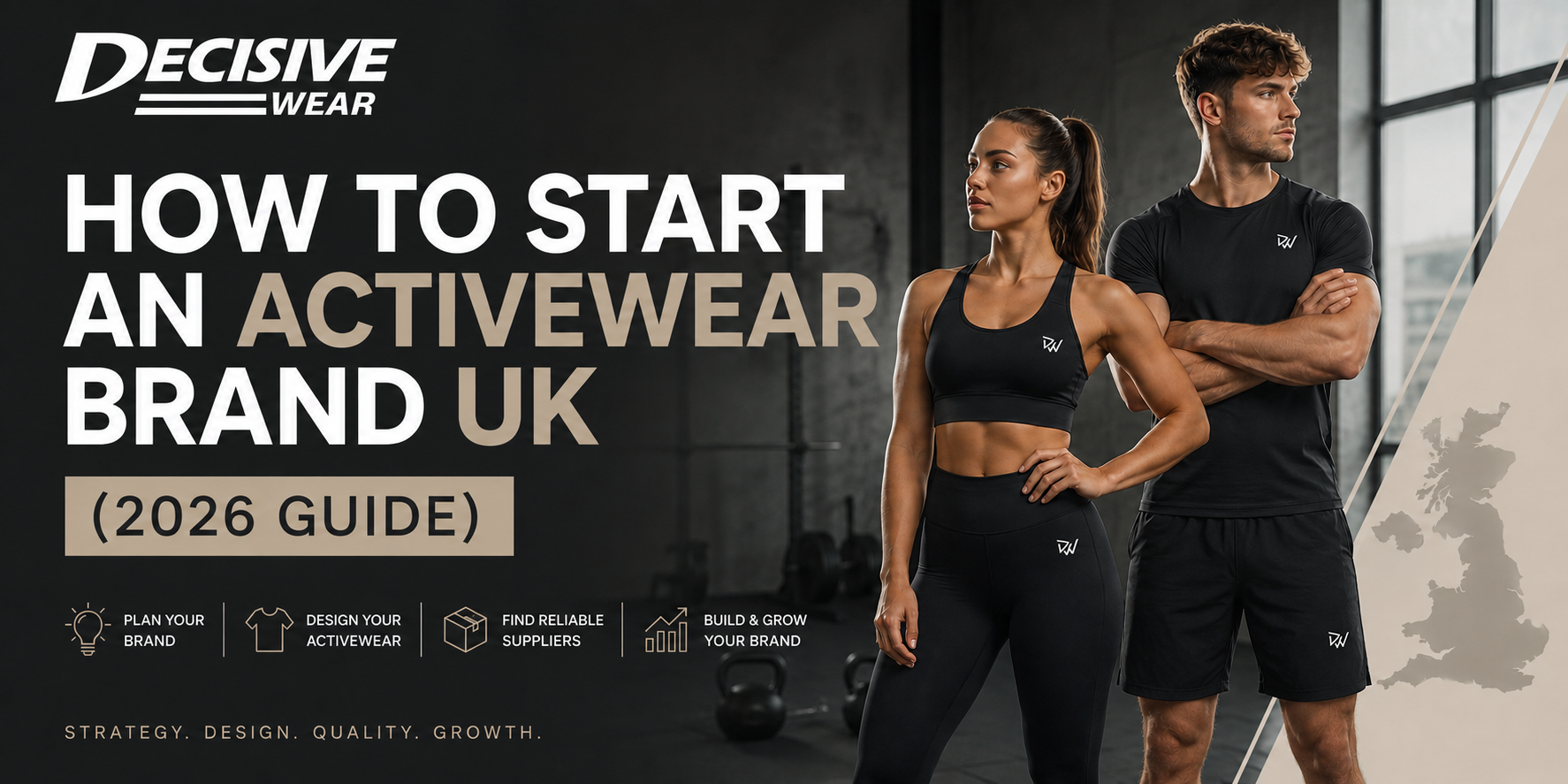
Starting your own activewear brand in the UK has never been more accessible — or more competitive. The UK fitness apparel market is growing year on year, with gym memberships at record highs and athleisure crossing over into everyday wear. But between the idea of launching a brand and actually having product in your hands, there are dozens of decisions to make.
This guide walks you through every stage of the process — from validating your concept to receiving your first production run at your door — based on how we work with gym owners, personal trainers, and fitness entrepreneurs at Decisive Wear every day.
Step 1: Define Your Brand Identity Before You Design a Single Garment
The most common mistake first-time activewear brand founders make is rushing to design before they’ve answered the fundamental brand questions. Your product range, pricing strategy, and marketing channels all flow from a clear brand identity.
Answer these four questions before you go anywhere near a manufacturer:
- Who is your customer? (Age, gender, fitness level, income bracket, lifestyle)
- What is your brand positioning? (Premium, accessible, niche performance, lifestyle-led)
- What makes you different? (Your story, your community, your product angle)
- What channels will you sell through? (D2C website, gym retail, Instagram, Amazon)
Clarity on these questions determines your fabric choices, your design aesthetic, your price points, and whether you should start with ODM base styles or fully original OEM designs.
Step 2: Decide Between ODM and OEM Manufacturing
When you approach an activewear manufacturer, you’ll encounter two manufacturing models: ODM (Original Design Manufacturing) and OEM (Original Equipment Manufacturing).
ODM — The Faster, Lower-Risk Route
In the ODM model, you select from a manufacturer’s existing range of base styles and customise them with your branding, colours, and finishing options. There is no need for complex tech packs or original design files — your manufacturer handles the technical side.
ODM is ideal for first-time brand founders because it reduces your startup costs, shortens your time to market, and lets you validate demand before investing in original design development.
OEM — Full Creative Control
OEM means you bring your own original designs and the manufacturer produces them exactly to your specifications. This requires tech packs, pattern development, and more detailed upfront investment — but gives you a product range that is entirely your own intellectual property.
Most successful UK activewear brands start ODM to generate initial revenue and brand awareness, then transition to OEM as the brand grows and design investment is justified.
Step 3: Find the Right UK Activewear Manufacturer
Choosing the right manufacturing partner is the most critical decision you’ll make. A bad manufacturing relationship — poor communication, inconsistent quality, missed deadlines, surprise costs — can destroy a brand before it ever builds momentum.
When evaluating manufacturers, prioritise these factors:
- Low MOQ: For a brand launch, you need a manufacturer who works from 100 pieces, not 1,000+
- Sampling: Any serious manufacturer will offer a physical sample before bulk production. If they don’t, walk away.
- Communication: UK-based support or a dedicated account manager is worth paying for — it prevents costly miscommunications
- DDP shipping: A manufacturer who quotes DDP (Delivered Duty Paid) means no surprise import costs on arrival
- Transparent pricing: Get a full breakdown including production, branding, shipping, and any tooling charges upfront
At Decisive Wear, we specifically built our service model around UK fitness entrepreneurs — with UK-based customer support, sampling as a standard process, and DDP shipping included. Our MOQ starts at 100 pieces precisely because we know the barriers that stop new brands from launching.
Step 4: Create Your Product Range
Your initial product range should be focused, not broad. A common startup mistake is trying to launch with 10 products — this ties up capital in stock, complicates your marketing, and makes operations harder to manage.
A strong activewear brand launch typically starts with 2-3 core pieces that form a cohesive range. For example:
- A performance t-shirt + matching jogger or shorts (a complete training set)
- A heavyweight hoodie as a hero brand piece (high perceived value, strong margins)
- A stringer vest if you’re targeting the gym and bodybuilding market specifically
Start with what your target customer needs most, in the colourways that match your brand aesthetic, and build from there based on what sells.
Step 5: Understand MOQ and Plan Your Investment
MOQ — Minimum Order Quantity — is the minimum number of units a manufacturer will produce per style. At Decisive Wear, our MOQ is 100 pieces per style.
For a starting order of 3 styles at 100 pieces each, you’ll be working with 300 total units. Your total investment will cover:
- Sampling costs (typically £150-£400 per style)
- Bulk production costs (per-unit costs vary by garment — request a quote)
- DDP shipping (included in your quoted price with Decisive Wear)
Plan your cash flow carefully. Your order is typically invoiced in two stages — a deposit before production begins and the balance before shipment. Understanding this timeline helps you plan your launch marketing, pre-order campaigns, or funding requirements.
Step 6: Submit for Sampling and Approve Before Bulk
Never skip the sampling stage. A physical sample gives you the opportunity to check fabric quality, fit, colour accuracy, print quality, and overall construction before committing to hundreds of units.
When you receive your sample, evaluate it against these criteria:
- Fabric weight and hand-feel — does it match the specification and your expectations?
- Fit and silhouette — try it on or have someone in your target size try it
- Colour accuracy — check against your original colour references in natural light
- Print and branding quality — check logo placement, print coverage, and durability
- Seam and construction quality — stress-test seams, check flatlock finishing
If adjustments are needed, request a revised sample. Only proceed to bulk production when you’re fully satisfied. The sample sign-off is your last checkpoint before the investment is committed.
Step 7: Plan Your Launch While Production Runs
With a production lead time of 4-6 weeks after sample approval, you have a window to build brand assets and marketing infrastructure while your first order is being manufactured. Use this time to:
- Build your website (Shopify is the go-to for activewear D2C)
- Create brand content — lifestyle imagery, flat lays, brand story video
- Build your social media audience — Instagram and TikTok are the primary channels for fitness apparel
- Set up email capture and a pre-launch waitlist if you want to build demand before stock arrives
- Plan your launch campaign — influencer seeding, paid social, organic content calendar
The Bottom Line
Launching a custom activewear brand in the UK in 2026 is entirely achievable with the right manufacturing partner, a focused product range, and clear brand positioning. The barriers — high MOQs, complex factory relationships, import logistics — have been significantly reduced by manufacturers like Decisive Wear who are built specifically to serve the UK startup market.
If you’re ready to take the first step, contact us for a free consultation. We’ll walk you through your product options, provide transparent pricing, and outline exactly what your launch timeline looks like from first conversation to product in hand.
Ready to launch your activewear brand? Get a free quote or request a sample today.